

The Grace-Led Life · Faith & Bible Study
Will verse mapping change the way you read Scripture? Yes! Will it require a little more time than quickly reading a verse on your phone? Also yes!
But here is the beautiful truth: slowing down is not falling behind. It is making room for God to speak, correct, comfort, and anchor you.
Verse mapping is a simple but powerful Bible study method that helps you explore one Scripture in depth. You examine its words, context, connections, and personal application instead of rushing past it. Think of it as tending one small patch of your spiritual garden until you discover how deep the roots really go.
You do not need a seminary degree. You do not need a shelf full of expensive resources. You need an open Bible, a willing heart, and a journal or Bible study tool that gives you room to think.
What Is Verse Mapping?
Verse mapping is the practice of taking a single Bible verse and studying it from several angles:
- The exact wording of the verse
- Important or repeated keywords
- Original Hebrew or Greek meanings
- Historical and literary context
- Related Scriptures
- Personal application and prayer
A verse map is not a way to force a verse to say what we want it to say. It is a way to honor the text before asking how it applies to our lives.
That distinction matters!
Surface-level Bible study asks, “What does this verse mean to me today?” Deeply rooted Bible study first asks, “What did this verse mean in its original setting, and what does it reveal about God?”
That is how we build an anchored faith journal, not one filled only with inspiring phrases, but one filled with truth.
Why Verse Mapping Deepens Your Understanding
We live in a fast-content world. We scroll, skim, save, and move on. Even our quiet time can become another task to complete.
Verse mapping invites you to stop.
When you study one verse carefully, you begin to notice details that a quick reading may hide. A single word can reveal God’s character. A surrounding passage can correct a misunderstanding. A cross-reference can show that one promise is part of a much larger biblical story.
This method also protects you from taking Scripture out of context. The enemy loves confusion, discouragement, and half-truths. But Scripture studied carefully becomes a north star. It helps you recognize what is emotionally appealing but spiritually inaccurate.
You are not merely collecting verses. You are cultivating wisdom.
And yes, you are a masterpiece, but spiritual growth still requires stewardship. Steward your attention. Steward your study time. Steward the Word God has placed in front of you!
How to Start Bible Journaling With Verse Mapping

Step 1: Choose One Verse
Begin with a verse that meets you where you are. It may be a promise you need to understand, a command you want to obey, or a passage that keeps returning to your heart.
For this example, we will study Jeremiah 29:11.
“For I know the thoughts that I think toward you, saith the LORD, thoughts of peace, and not of evil, to give you an expected end.”
, Jeremiah 29:11, KJV
Write the verse in your preferred translation. Then, if helpful, write it in one or two additional translations. Comparing wording can highlight important ideas without changing the central message.
If you are learning how to start Bible journaling, remember: your first page does not need to look perfect. It needs to be honest, thoughtful, and rooted in Scripture.
Step 2: Write the Verse Out
Writing Scripture by hand slows your mind down enough to notice it.
Copy the verse carefully into your journal. Leave space beneath it for notes. You can underline repeated words, circle phrases that stand out, or use a simple color system:
- Deep plum-grey: Main Scripture
- Dusty rose: God’s promises
- Misty sage: Context and cross-references
- Petal pink: Personal reflection
You can also use a Bible highlighting guide to create a consistent system throughout your study.
Step 3: Identify the Keywords
Now look for the words carrying the weight of the verse.
In Jeremiah 29:11, you might highlight:
- I know
- thoughts or plans
- peace
- not of evil
- future
- hope
Do not rush this section. Ask yourself: Which words are repeated? Which words describe God? Which words describe His purpose for His people?
Step 4: Explore Hebrew or Greek Word Meanings
You do not need to become a biblical-language scholar. Use a trusted Bible dictionary, concordance, or resource such as Bible Hub’s interlinear text to explore key words.
For Jeremiah 29:11, these Hebrew terms are especially meaningful:
- Yadati , “I know.” This comes from a word associated with knowing deeply or relationally.
- Machashavot , “thoughts,” “plans,” or “designs.” This points to intentional purposes, not random ideas.
- Shalom , often translated “peace,” but also carrying ideas of wholeness, welfare, completeness, and well-being.
- Acharit , “future,” “outcome,” or “latter end.”
- Tikvah , “hope” or confident expectation.
Write the word, pronunciation, basic meaning, and what it reveals about God.
A gentle reminder: word studies should illuminate Scripture, not become a way to invent secret meanings. Always consider the whole passage.
Step 5: Note the Context
This is where verse mapping becomes especially important.
Jeremiah 29:11 was written to Jewish exiles living in Babylon. They were not sitting in a season of convenience. They were displaced, grieving, and waiting. Through Jeremiah, God instructed them to build homes, plant gardens, seek the welfare of the city, and remain faithful during a long season of exile.
The promise in verse 11 comes within that larger message. God had not abandoned them, but He also had not promised instant escape. Jeremiah 29:10 refers to a seventy-year period before restoration.
Read Jeremiah 29:1–14 and write down:
- Who was speaking?
- Who was receiving the message?
- What was happening historically?
- What instructions came before and after verse 11?
- What did the promise mean to the original audience?
This context does not make the verse less comforting. It makes it more trustworthy.
God’s plans can be good even when the current chapter is painful. His timing can be faithful even when it is not immediate. That is a hard truth, but it is a hope-filled one!
Step 6: Cross-Reference Related Verses
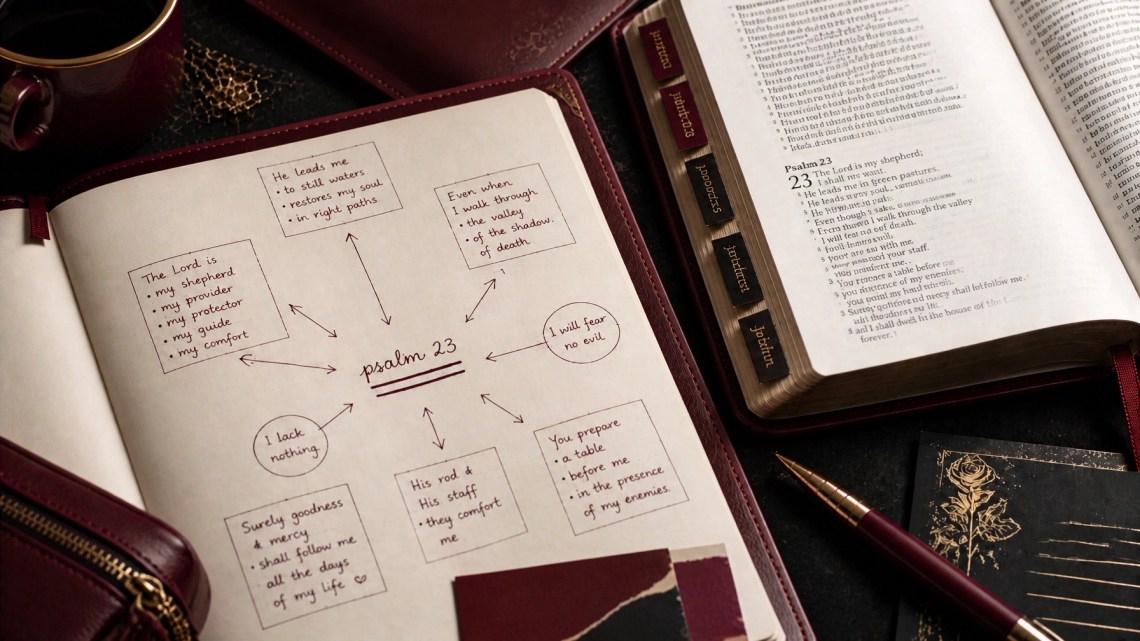
Scripture interprets Scripture. Look for passages that connect through themes such as hope, peace, restoration, purpose, or God’s plans.
Consider studying:
- Jeremiah 29:10–14 , the immediate context
- Isaiah 55:8–9 , God’s thoughts and ways are higher than ours
- Daniel 9:2 , Daniel reflects on Jeremiah’s prophecy
- Romans 8:28 , God works for good in the lives of those who love Him
- Proverbs 23:18 , there is a future, and hope will not be cut off
Draw lines between related ideas. Create a small “theme garden” on your page:
God’s plans → peace → patience → prayer → hope → restoration
Step 7: Write Your Personal Application
Only after studying the verse’s original meaning should you ask how it shapes your life today.
Jeremiah 29:11 was originally spoken to Israel in exile. It is not a guarantee of an easy life, instant success, or every personal dream unfolding on your preferred timeline.
But it does reveal something eternally true about God: He is purposeful, faithful, and not careless with the lives of His people.
Ask:
- What does this verse reveal about God’s character?
- Where am I tempted to believe God has forgotten me?
- What would faithful stewardship look like in this waiting season?
- What action is God asking me to take today?
- How can I seek His peace instead of demanding immediate answers?
You are not a forgotten woman wandering without direction. You are a key part of God’s plan. Your assignment may feel hidden, but hidden does not mean insignificant. Seeds grow in darkness before they break through the soil!
Bible Journaling Prompts for Your Faith Journal
Use these prompts beneath your verse map:
- What phrase in this verse do I need to sit with longer?
- What did this Scripture mean to its original audience?
- What does this passage teach me about God?
- What fear is trying to compete with this truth?
- Where do I need patience, obedience, or courage?
- What practical step can I take this week?
- How can I pray this verse over my home, work, relationships, or calling?
- What would trusting God’s timing look like today?
Record your answers in a Christian planner or journal so your study can become part of your everyday rhythm, not just a beautiful page you create once.
A Simple Verse-Mapping Template
For any future Scripture, use this pattern:
- Text: Write the verse in one to three translations.
- Keywords: Circle important words and phrases.
- Language: Explore Hebrew or Greek meanings with trusted tools.
- Context: Study the surrounding verses, audience, and setting.
- Cross-references: Find related passages and themes.
- Application: Write what God is inviting you to believe, do, or surrender.
- Prayer: Respond to Him honestly.
You do not have to map an entire chapter today. Start with one verse. One page. One faithful yes.
A Prayer for Your Bible Study
Father, thank You for giving us Your Word as an anchor, a lamp, and a living source of hope. Help me slow down and study with humility. Guard me from pulling verses out of context or using Scripture to support what I simply want to believe. Give me wisdom to understand, courage to obey, and patience to trust Your timing.
Reveal Your character to me through every word. Strengthen me against the enemy’s lies. Help me steward my calling, my attention, and my season well. Plant Your truth deeply in me until it produces peace, purpose, and faithful action.
In Jesus’ name, amen.

Beautiful woman of God, you do not need to study perfectly to study faithfully. Bring your questions. Bring your highlighters. Bring the parts of your heart that still feel uncertain.
God meets you there.
Keep growing. Keep mapping. Keep allowing His Word to become rooted in you.
You are a winner, a masterpiece, and a woman with a God-given purpose. I am cheering you on every step of the way!
With grace,
Charlet


